5 Types of Agentic Systems Operators Should Know About
Agentic systems are becoming operators' most powerful AI tools, deployed across sales, marketing, product, and engineering. Here are five types to know.
Agentic systems are emerging as operators' most powerful AI tools. They're being deployed in all kinds of organizations, from sales and marketing to product and engineering. After building operations systems for over 20 teams at fortune 500 enterprises and growth stage startups, we've come to appreciate the nuances among different AI agents.
What are agentic systems?
If you've tried using tools like ChatGPT for real work projects, you've probably seen LLMs fall on their face in predictable ways. They make mistakes, can't take actions in the real world, and forget important information.
AI Agents were invented to overcome these limitations. Equipped with goals, tools and feedback mechanisms, agents are capable of completing complex workflows over extended periods of time.
However, it's rare to see an agent deployed into a real work environment by itself. In practice most agentic products are actually systems, rather than individual agents in isolation. These systems are comprised of building blocks, including tools, memory, project context, and even other agents.
The more sophisticated the system, the larger the projects and workflows it can handle. And of course it's this high-impact work that creates the most value within any organization.
Why operators should understand agentic architectures
AI systems play a larger role in day-to-day business operations than ever before. They A/B test marketing campaigns, drive sales pipelines, and triage customer support tickets. Effective human-AI collaboration is often the difference between achieving transformational ROI from AI and struggling with it. As an operator, therefore, you can't afford to have a major blind spot here.
Describing exactly how these systems work gets a bit technical, but understanding them actually makes it easier to visualize what AI agents will look like inside your company. Different systems architectures provide agents with varying capabilities. Some are great at reliably completing simple tasks, while other excel at tackling the most complex challenges over the course of hours.
The 5 Types of Agentic Systems
Systems of AI agents can be broken down into 5 types, each with distinct tradeoffs. While some are more common than others today, the landscape is evolving rapidly and each has its place.
Type 1: Solo agent
Description
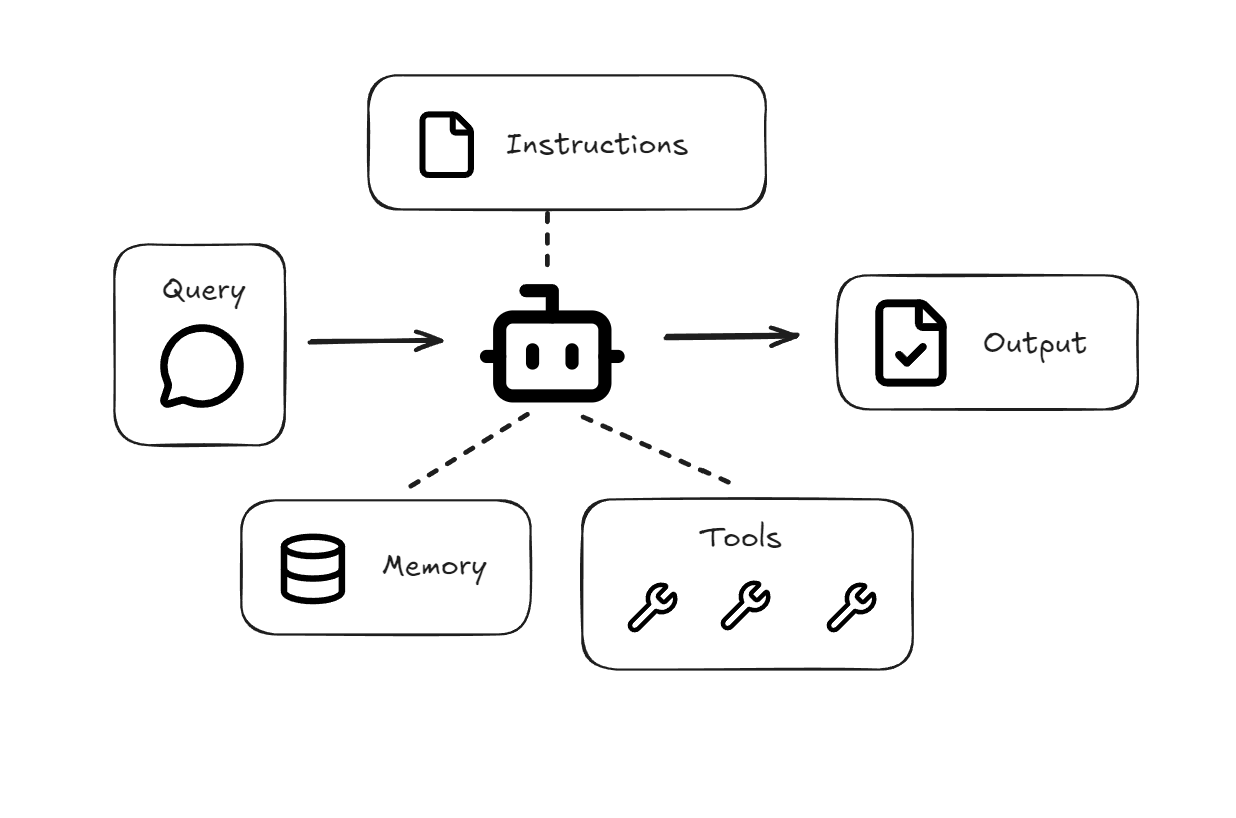
This is the simplest possible agent, consisting of a single LLM (such as OpenAI's GPT series, Google's Gemini, or something else), equipped with tools* and a set of instructions. After receiving a query, the agent will complete the request provided in its instructions using the tools available as needed.
Note that "tool" in this context means a computer program built for the agent, such as web search, app integration (ERP, CRM, email, etc), or other special abilities. Tools can also include guardrails that instruct the agent to ask the user for input or escalate to a human when it encounters uncertainty, edge cases, or high-stakes decisions.
Strengths of solo agents
- Easy to implement in no-code and low-code platforms
- Cheap to run and maintain, because there aren't many moving parts
- Best choice for simple tasks with predictable inputs and outputs
Weaknesses
- Unreliable for very complex workflows
- Will get overwhelmed by too much context or too many tools
Examples
- Web research agent
- Internal knowledge base Q&A agent
- Email writing agent
Type 2: Sequence of agents
Description
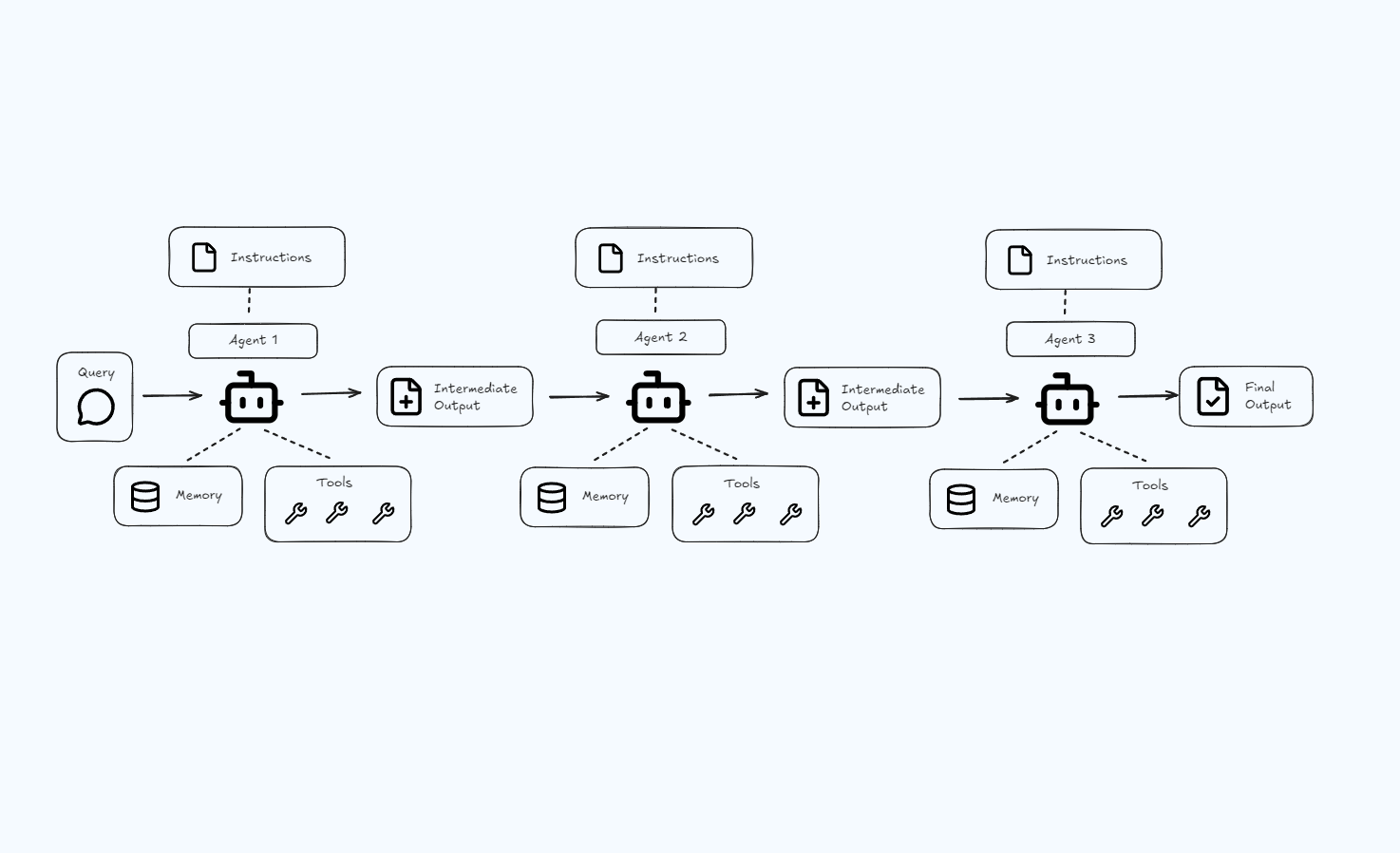
A sequence of agents involves multiple agents completing a workflow by chaining tasks together one after the other, like a conveyor belt. The first agent receives a query, performs a task, then passes its output to the next agent. All agents in a sequence perform their tasks in the same order every time (though this type does support conditional workflow logic).
Strengths
- Handles complex workflows with many steps
- Enables task specialization between agents
- Easy to test and evaluate because intermediate outputs are predictable
Weaknesses
- Struggles to handle unexpected scenarios and inputs
- Errors made early in sequence cascade throughout workflow
- Simplistic decision making capabilities
Examples
- Sales prospecting agent
- Compliance review agent
- ERP/CRM data enrichment agent
Type 3: Evaluator-supervisor
Description
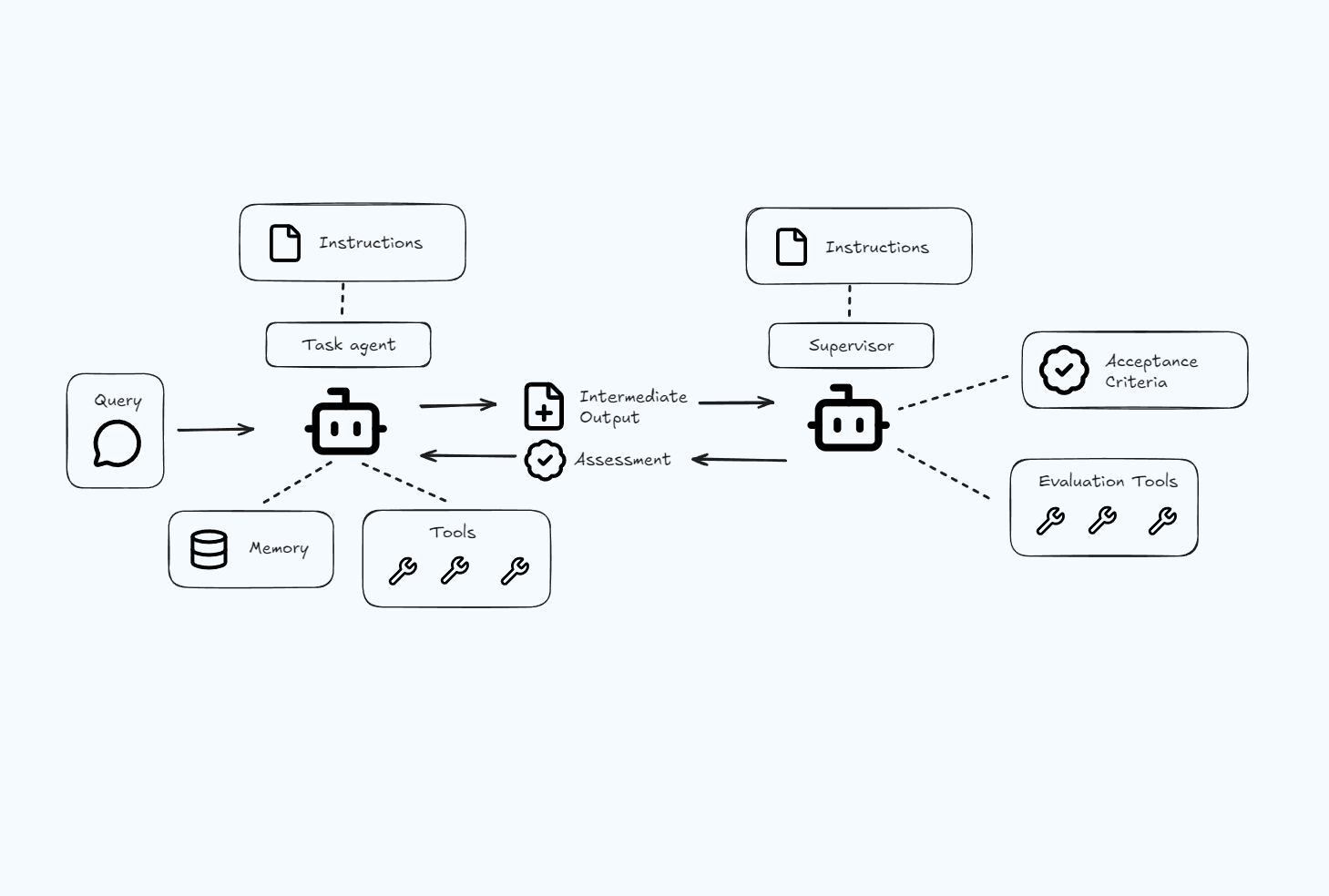
In this pattern, one agent performs a task while a second agent evaluates the output before it proceeds. The evaluator checks for quality, accuracy, or compliance with requirements—and can send work back for revision or flag it for human review. This creates a built-in quality control loop without too much complex orchestration.
Strengths
- Reliably catches errors before they propagate
- Adds trust without excessive complexity
- Natural fit for high-stakes or compliance-sensitive workflows
Weaknesses
- Evaluator agent needs clear criteria to assess against, or it will fail
- Can slow down task execution
Examples
- Document drafting with compliance check
- Data entry with validation
- Software code generation with review
Type 4: Orchestrator agent + subagents
Description
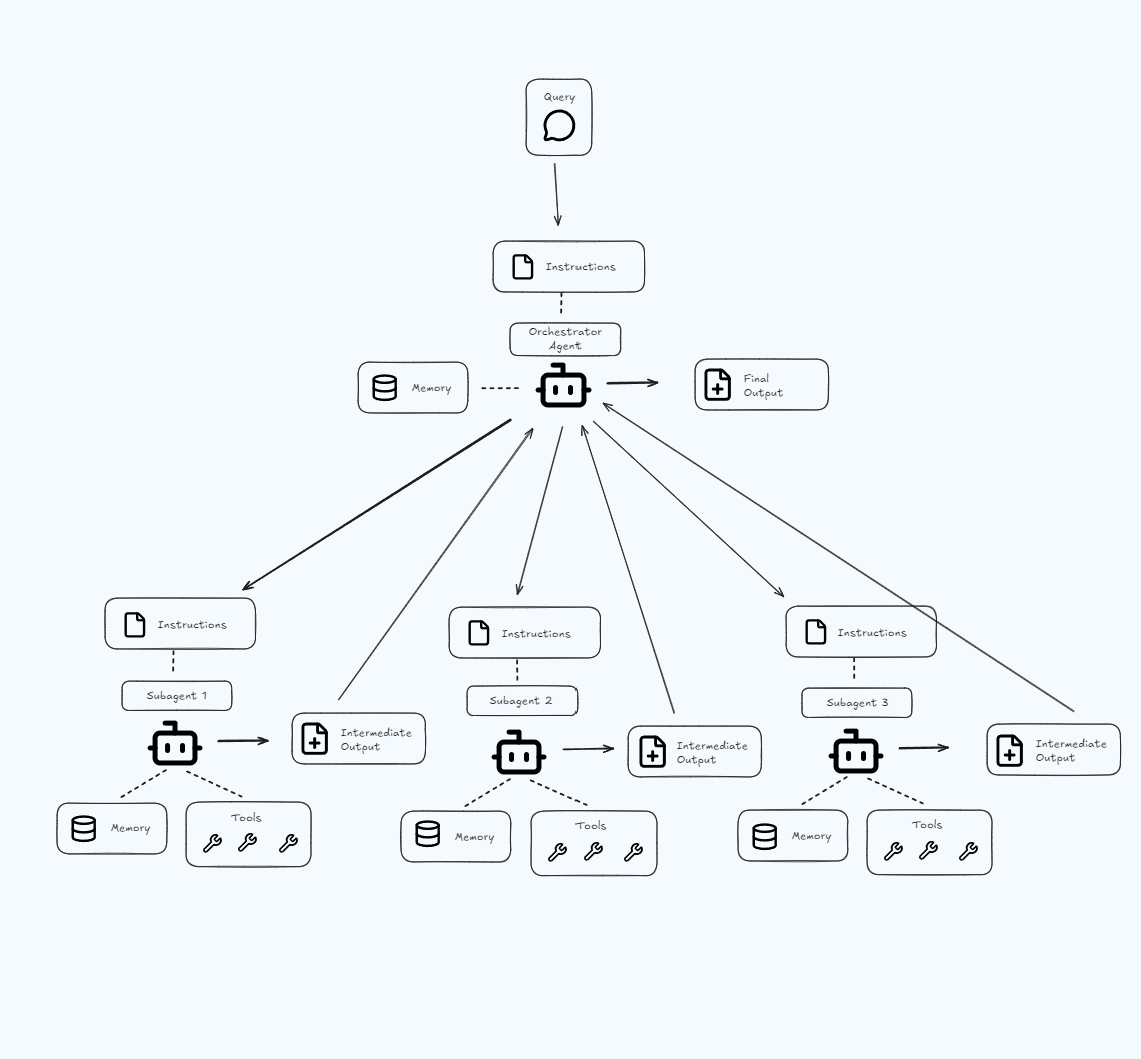
This agentic system mimics a manager delegating task execution to individual specialists. A primary agent handles user interaction and breaks down high level objectives into sub-tasks, then delegates to specialized agents for execution. The orchestrator's job is to lead the team towards the ultimate goal, while each subagent is only responsible for their own specific task.
Strengths
- Highly versatile, can automate many different tasks at once
- Capable of achieving objectives under ambiguity
- Each subagent may have its own specialized knowledge and tools
Weaknesses
- The system can become very complex
- Challenging to measure and evaluate agents in isolation
- Often slow because of task handoffs
Examples
- Personal assistant agent
- Price estimation agent
- Content marketing agent
Type 5: Collaborative multi-agent systems
Description
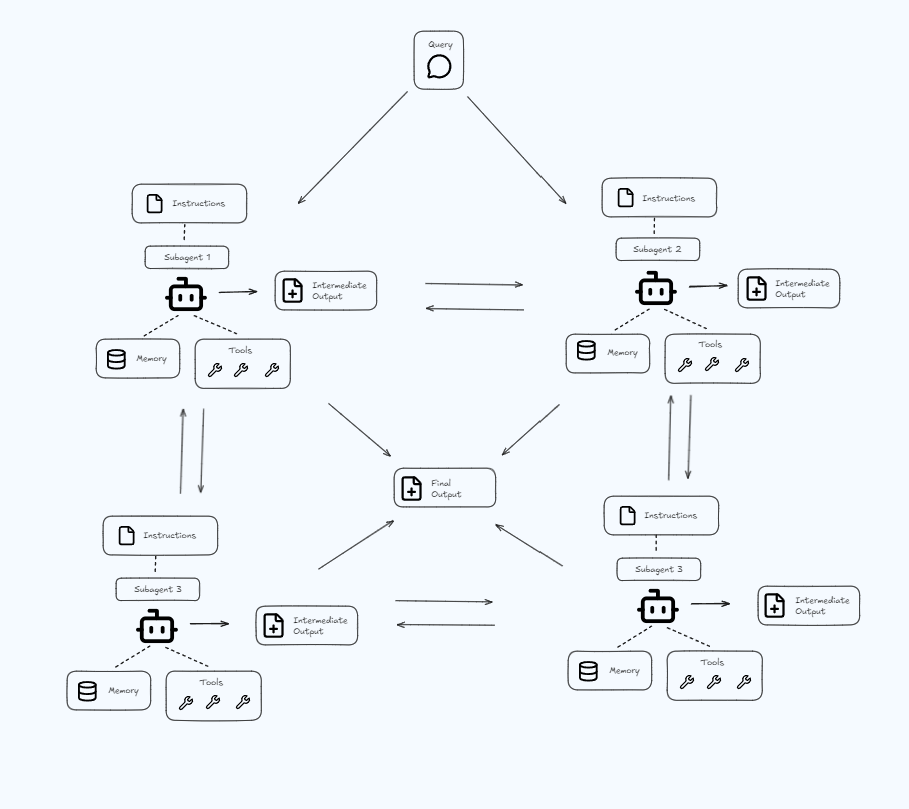
This agentic system is the most sophisticated, mimicking a team of peers with different complementary specialties. Each agent has its own objectives and they negotiate or collaborate accordingly. In this system, agents communicate peer-to-peer without a central orchestrator.
This type of system is the subject of active research and development. It's rarely used at scale in business today.
Strengths
- Useful for sophisticated simulations of multiple entities
- Can be used to strategize and execute towards any arbitrary goal
Weaknesses
- The system can become extremely complex
- Agents in this system struggle to maintain coherence, even with cutting edge models
- Very challenging to measure and evaluate
Examples
- Red team/blue team adversarial simulations
- Diplomacy/negotiation simulations
Ready to make your AI work?
Book a 30-minute call to talk through what's not working and whether we can help.