An Introduction to AI Agents for Operators
AI agents are transforming both what businesses accomplish and how we work. Learn how agentic products work and how to bring them into your workflows.

Introduction
AI agents are transforming every aspect of business, impacting both what we're able to accomplish, as well as how we work. Even if you're not an engineer, it's more important than ever to understand how agentic products work as they become embedded into your day-to-day.
Teams as diverse as Operations, Marketing and Design are deploying millions of AI agents themselves to automate manual processes and deliver work that was not possible before. While the ecosystem is evolving quickly, anyone can learn how to incorporate AI agents into their workflows.
We've spent the past three years building and deploying agentic systems for dozens of organizations—from early-stage startups to established enterprises—and this introductory guide distills what we know into a practical survey.
What is an AI agent?
The term AI agent has become so oversaturated in industry media that I'd forgive you for rolling your eyes. I've been to enough conference keynotes over the years that my eyes also start to glaze over at every breathless mention of "agentic AI". But unlike the blockchain craze of 5 years ago, this one has real substance underneath the hype.
My favorite definition of AI agent comes from Google:
AI agents are software systems that use [large language model (LLM)-based] AI to pursue goals and complete tasks on behalf of users. They show reasoning, planning, and memory and have a level of autonomy to make decisions, learn, and adapt.
Key characteristics
The key points to understand here are Goals, Tools, and Memory.
Goals are critical for aligning agent actions with your intentions. You can give an agent instructions about what to do (and what not to do), and it will be able to chart a course towards achieving the desired outcome, such as producing a deliverable that meets certain acceptance criteria.
Tool Use is what enables proactive action and the ability to interact with the outside world. While working, AI agents can use other software applications, query databases, and even escalate issues to humans in order to accomplish their tasks.
Memory enables agents to understand the context in which they work, and adapt over time. Types of memories might include entity descriptions (i.e. product specs, customer profiles), standard operating procedures, timelines of events, and even internal proprietary data such as email correspondence.
These characteristics make AI agents capable of taking on highly complex and dynamic workflows that a traditional robotic process automation (RPA) system would fail at. That flexibility, combined with LLM's impressive reasoning ability, is what makes AI agents so powerful across a wide range of applications like administrative work, sales & marketing, computer programming, and design.
How agents differ from chatbots and assistants
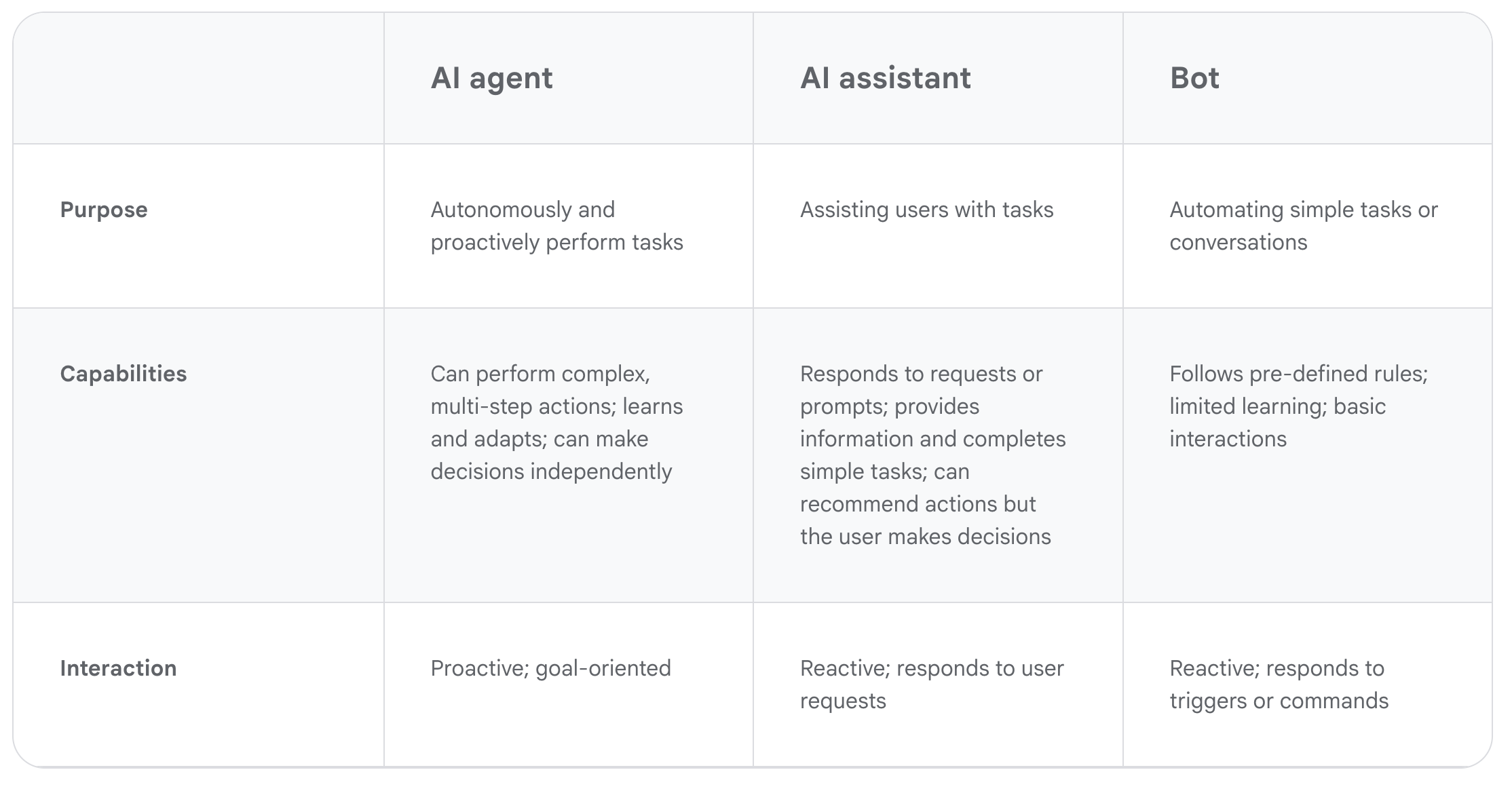
The key differentiator between true AI agents and other AI assistants or chatbots is autonomy and proactivity. Agents can be given a high level goal, such as "resolve this ticket" and will be able to take whatever actions are needed, within their guardrails, to accomplish it.
Where can you get AI agents?
Many software products from Notion to Salesforce nowadays include AI agents in their offerings. The big AI research labs, OpenAI and Anthropic, also sell their own powerful agents as standalone products primarily built for software developers.
However, if you don't want to purchase one of these products you could also create your own using many popular no-code or low-code tools. Platforms like Zapier, n8n, and Clay make it very easy for anyone to create their own AI agents using their simple building blocks.
In some cases, you might ask an internal team or outsourced developer to build a custom agentic tool for you. But generally speaking, the products you can get off the shelf are more than enough for most use cases.
What agents are capable of
Agents are being deployed across nearly every business function: sales research and prospecting, customer support, marketing content generation, compliance review, data entry and enrichment, financial reporting, HR onboarding, and more.
Types of tasks/problems they handle well
Agents excel when they are working within structure and have objective success criteria like conversion rate or ticket resolution time. Here are a few examples of where we've seen a lot of good results to date, though the list isn't exhaustive by any means:
- Large scale data processing — AI is really good at reading large volumes of data as a part of research, summarization, classification, and analysis workflows.
- Repeatable workflows — Tasks like sales prospecting or issue triage are natural fits for AI agents, or sequences of agents.
- Data Hygiene — Agents are great at the tedious work of moving information between apps, enriching CRM records and keeping databases in sync.
What agents struggle with
The biggest gotcha to watch out for when working with agents is goal ambiguity. When success criteria are vague or subjective, agents struggle to perform well without active human oversight and guidance. Additionally, unexpected situations where agents receive inputs that they do not know how to handle will often cause them to improvise poorly.
How to work with AI agents
When you work with LLM chatbots like ChatGPT, you often think hard about the prompts you write. With AI agents you also have to think hard about the context you provide.
What is agent context?
Context is all of the information that an AI agent has at its disposal to understand and execute its instructions. This includes many different types of information, including:
- Prompts
- Memories
- Knowledge bases (e.g. an internal Wiki)
- Structured databases
Like any LLM-based product, agents can only hold a limited amount of data at a time (this is what's referred to often as a context window). This means that folks who build agentic systems have to prioritize what information they provide to agents.
Setting agents up for success
Similarly, when you collaborate with an AI agent you have to be very mindful of what context it already has about your project. It will only be an effective collaborator if it has access to all of the information it needs to do its job well.
LLMs are like super geniuses showing up for their first day of work. They are very smart and know a lot of general information, but have no idea about your internal information or internal processes.
For example, let's say you're working with an agent on customer research. You can assume it knows customer research best practices. But it probably doesn't already know the details about your solution and your typical customer profile. It will also need a mechanism to access CRM records in order to be most effective.
If an agent is prompted to complete a task but is missing critical background information, that's often when you see low-quality outputs and nonsense answers. If you're unsure about what an agent already knows, you can often ask it to verify.
Organizational AI agent adoption models
When companies decide to invest in AI agents across their organization, they typically do it in one of 3 ways. I hope I'll be able to convince you, though, that the third one is far superior to the first two.
Top-down rollout
This one is pretty self-explanatory. Leadership builds a strategy, chooses vendors, and drives AI agent deployment in day-to-day workflows. This approach ensures quick alignment and provides every department with useful shared infrastructure. But too often it leads to subpar results by being out of touch with what is actually important in the day-to-day.
Bottom-up rollout
Also straightforward, a bottom-up approach lets individual teams experiment and adopt agentic tools on their own. This produces high relevance to actual work but creates fragmentation without shared infrastructure. Without a single source of truth, it can often be hard to sustain the support the automation required for substantial ROI from AI.
Hub-and-spoke rollout
The most effective AI agent rollouts take a hybrid approach that allocates strategic responsibility where it's best suited. A central team owns shared infrastructure, sources of truth, and platform vendors.
Then individual departments own their own strategies, specialized tools and execution. They choose what to automate and plug their own agents into the shared system. This balances alignment with autonomy. The scaffolding is a shared resource that every team is free to operate within.
Real world examples of AI agents in action
At Revi Systems, we've deployed agents across a range of complexity. The simplest was a CRM data hygiene agent using FullEnrich and n8n that automated copying deal data between systems, saving thousands monthly. More comprehensive in nature was a partnership with an enterprise data platform to transform their sales operations around AI agents, targeting 50% workflow automation.
This example is a perfect demonstration of hub-and-spoke in practice. First we deployed the shared infrastructure: a graphRAG-based knowledge base in Aomni encoding their SOPs, account history, and strategic priorities. This all comprised the memory layer that gives agents the context they need to avoid goal ambiguity.
Then the specialized task-specific agents plugged into that foundation to automate account research, prioritization, email prospecting, and RFP/RFI completion. Each agent had clear, objective success criteria determined by front line management and validated through testing.
The results were transformational. They saw the expected 50% reduction in manual work across the pipeline (80% for account management), plus a 45% pipeline velocity increase. Success came from engineering a holistic system, starting with the shared knowledge layer and followed by function-specific agentic workflows.
Conclusion
AI agents are here now, accessible to any operator curious enough to learn how they work. The playbook to get started is simple - start with the knowledge layer: encode your SOPs, data, and institutional memory into systems agents can access. Pick a narrow workflow with objective success criteria and automate it. When you're ready to expand, do so strategically.
The companies seeing real ROI right now have invested in AI operations systematically with a focus on context engineering and team enablement. The technology and products that use it will keep evolving, but don't let that stop you from building the organizational muscle to use it.
Ready to put these concepts into practice? Start small—pick one repeatable workflow like sales prospecting, issue triage, or CRM data hygiene, build an agent for it, and expand from there.
Ready to make your AI work?
Book a 30-minute call to talk through what's not working and whether we can help.